
By Eman Hamed
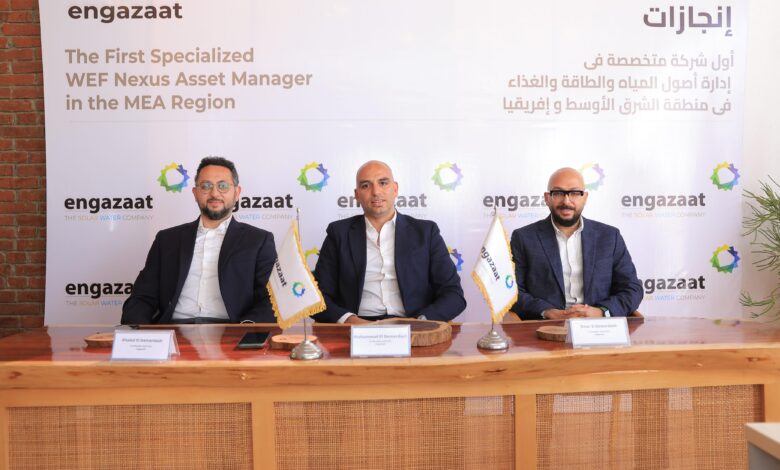
engazaat, the Middle East and Africa’s (MEA) first specialized asset manager in water-energy-food (WEF) systems, announced plans to invest more than USD 100 million to support its regional expansion in climate infrastructure, as part of a total USD 250 million project portfolio currently under development.
Founded in Egypt in 2011, engazaat brings 14 years of developing and operating a utilities-as-a-service model for water, energy, and food systems. As a specialized manager of these sustainable systems, engazaat has invested USD 33 million in its existing projects, developed more than 63 MW of solar capacity – enough to power 40,000 homes – and actively manages over 15 million cubic meters of water annually for agricultural purposes.
The company is currently expanding to operate across three countries through long-term service and utility offtake agreements with commercial, agricultural, and industrial clients under a Build–Own–Operate (BOO) model.
engazaat works across three connected systems: Water, renewable energy, and food production. The platform invests in and operates sustainable infrastructure projects that serve farms, businesses, and communities in Egypt and across the region.
Muhammad El Demerdash, founding partner and CEO of engazaat, said: “We approach water, energy, and food infrastructure as one connected investment case. When these systems are designed and financed together, they perform better and cost less to run. That is the model we have been building and operating for over 14 years, which shows that integrated infrastructure across emerging markets can deliver stable returns and measurable impact in remote areas, and aid in achieving sustainable development goals.”
engazaat runs projects through a utilities-as-a-service model. Clients pay for delivered services such as irrigation and/or water pumping and treatment, as well as the generation, transmission and distribution of renewable electricity, instead of buying and building the infrastructure themselves. engazaat develops, owns, and operates the assets. This approach reduces upfront cost barriers for clients and creates stable, performance-based revenue.
engazaat has also launched the SAVE Sustainable Infratech Fund as a direct financing mechanism; a USD 200 million investment platform that has been announced in partnership with CI Capital, one of the largest investment institutions in Egypt and the Middle East. The fund will be subject to regulation and oversight of financial regulatory authorities in Egypt and Abu Dhabi, in accordance with a timeline whose details will be announced by the founders.
The fund is considered one of engazaat’s core investment vehicles to support its expansion into clean infrastructure projects across target markets.
One of engazaat’s flagship projects is SAVE-1 in the Dakhla Oasis in Egypt’s New Valley governorate. The project combines renewable energy and water systems to support agricultural activity in the area. It is expected to reduce more than 460,000 tonnes of CO₂ throughout its operating life and create local jobs.
engazaat is also a signatory to the Abu Dhabi Global Sustainable Finance Declaration, committed to applying internationally recognized climate finance standards. The company also adheres to the highest levels of governance and compliance with applicable rules and regulations across all markets in which it operates, supporting the mobilization and deployment of investments required for its expansion plans.
In recognition of its role in advancing sustainability, engazaat has received multiple regional and international awards for its climate infrastructure and execution model, including the Egypt Entrepreneurship Awards Disruptive Duo Award for its project with Nestlé, Solar Quarter Power 100 Middle East recognition, the Solar Icons Award for leadership in advancing solar energy, and Gold recognition at the MENA Stevie Awards.
The platform continues to expand its pipeline across water, energy, and food infrastructure projects designed for commercial performance and measurable climate impact.