
University of Dubai and AIJRF Launch the 6th Artificial Intelligence Journalism World Forum on November 25–26, 2026

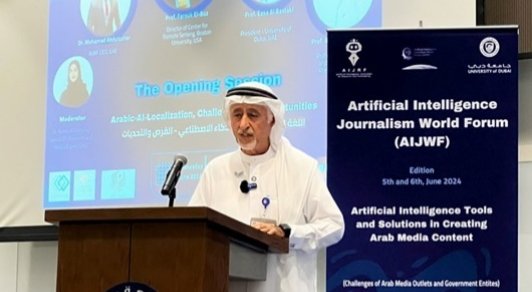
The Artificial Intelligence Journalism for Research and Forecasting (AIJRF), in collaboration with the University of Dubai, has announced the launch of the 6th Artificial Intelligence Journalism World Forum (AIJWF 2026), to be held on November 25–26, 2026, at the University of Dubai.
The sixth edition will be held under the main theme:
“Agentic AI and Digital Content Flow: Powering the Global Digital Economy and Governing AI-Driven Content”. The Forum will also mark six years of international impact under the slogan:
“Six Years of Impact: Building the Global Ecosystem of Agentic AI and Content Creation
Al Bastaki: The UAE Is Strengthening Its Position as a Global Hub for the Digital Economy and Agentic AI
H.E. Dr. Eesa Mohammed Al Bastaki is the President of the University of Dubai and member of the Advisory Board of AIJRF, said that the sixth edition of the Forum comes at a time when the world is witnessing unprecedented expansion in the integration of Agentic AI across multiple sectors.
“We are entering a new phase that is not simply about the advancement of AI tools, but about rebuilding business models, services, and the digital economy around increasingly autonomous intelligent systems. This rapid growth makes the need for governance and professional and ethical standards more urgent than ever, because meaningful innovation must combine technological capability with trust and responsibility.”
Dr. Al Bastaki emphasized that the UAE continues to strengthen its infrastructure and investment in the digital economy and Agentic AI, noting that the UAE Digital Economy Strategy aims to double the contribution of the digital economy to GDP from 9.7% to 19.4% within ten years.
He added: “The scale of global investment and partnerships attracted by the UAE reflects international confidence in its digital ecosystem. One example is Microsoft’s announcement of planned investments totaling USD 15.2 billion in the UAE between 2023 and 2029, covering AI and cloud infrastructure as well as broader technology ecosystem investments. These figures confirm that the UAE is moving beyond technology adoption toward building an integrated economy powered by artificial intelligence and innovation.”
He stressed that universities will play a central role in this next phase by preparing talent capable not merely of using intelligent systems, but of designing, managing, and governing them. Pasted text.
Abdulzaher: We Are Entering the “Third Revolution of Artificial Intelligence”
H.E. Dr. Mohamed Abdulzaher, CEO of the Artificial Intelligence Journalism for Research and Forecasting (AIJRF) and President of the 6th Artificial Intelligence Journalism World Forum, said that Agentic AI now represents a structural transformation in content creation and the digital economy rather than a limited technological development.
“Anyone observing what we may describe as the rapidly accelerating third revolution in artificial intelligence — the Agentic AI Revolution — can clearly see that we are witnessing a fundamental shift in how AI is used. The first phase centered on analysis and prediction; the second was driven by generative AI and content creation; while the third is defined by systems capable of planning, executing, coordinating, and taking actions with increasing levels of autonomy.”
Dr. Abdulzaher added that the AI Agents industry has rapidly moved from experimentation toward large-scale enterprise infrastructure.
Current estimates indicate that the global Agentic AI market reached approximately USD 7.84 billion in 2025 and is projected to reach USD 52.62 billion by 2030, representing a compound annual growth rate of 46.3%. Meanwhile, the Vertical AI Agents segment is expected to record a CAGR of approximately 62.7% over the same period.
He continued: “These figures show that Agentic AI is moving into the core operational infrastructure of institutions. We are talking about specialized AI agents in media, education, law, healthcare, banking, marketing, government services, and scientific research. We are also witnessing the transformation of traditional applications themselves into Agentic AI tools that do not simply wait for user instructions, but can plan, execute, interact with other systems, and complete entire workflows.”
Dr. Abdulzaher emphasized that content creation will be among the sectors most significantly affected by this transformation.
“We are gradually moving from a model in which humans lead every stage of the production process toward environments where AI agents can manage research, analysis, editing, video production, publishing, distribution, verification, and performance measurement, with varying levels of human supervision. This opens the door to what can be described as semi-autonomous production — and, in specific processes, content production without direct human intervention.” Pasted text
Agentic AI at the Heart of the New Digital Economy
AIJWF 2026 will bring together a distinguished group of academics, researchers, technology experts, media leaders, executives, AI specialists, content creators, and digital economy professionals to explore the rapid transformations being driven by Agentic AI across media organizations, businesses, markets, universities, government services, and digital platforms.
The Forum will focus on the transition from using generative AI primarily as an assistive technology toward a new era in which AI Agents can plan, reason, manage workflows, coordinate across systems, and execute sequences of tasks with varying degrees of autonomy and human supervision. Pasted text
Seven Key Themes Shaping the Future of Agentic AI
The sixth edition of AIJWF will examine seven major themes reflecting the economic, media, professional, and societal transformations associated with Agentic AI:
1. The Era of the Agentic AI–Driven Digital Economy
Exploring the transition toward economic ecosystems in which intelligent agents can manage multiple operations while interacting with data, platforms, and institutional systems.
2. Agentic AI and Digital Content Flow: The New Infrastructure of the Global Digital Economy
Examining how the entire digital content lifecycle is being redesigned — from research and data collection to production, editing, verification, personalization, distribution, analytics, and impact measurement.
3. Agentic AI–Driven Innovation Models: Redefining Media, Business, and Market Influence
Focusing on emerging economic and operational models powered by AI agents across media, marketing, customer service, market intelligence, and operational management.
4. Governing Agentic AI–Driven Content: Ethics, Regulation, and Public Trust
Addressing accountability, transparency, intellectual property rights, privacy, content verification, human oversight, and professional disclosure standards as intelligent systems gain increasing autonomy in producing and managing content.
5. Agentic AI for Good: Human-Centred Intelligence in the Digital Economy
Exploring applications of Agentic AI in education, scientific research, government and community services, healthcare, and sustainability.
6. Human Talent vs. Agentic AI: Competition or Collaboration?
Examining the future of employment, the changing nature of professional skills, and the evolving relationship between humans and autonomous AI systems.
7. From Innovation to Impact: Shaping the Future of Agentic AI–Powered Content Economies
Discussing the transition from limited experimentation toward scalable AI agent ecosystems capable of delivering measurable economic and institutional impact. Pasted text
Governing Content Produced by AI Agents
A major focus of AIJWF 2026 will be the governance of AI agent–generated and AI agent–managed content as intelligent systems become increasingly autonomous.
Forum sessions will address issues including:
Accountability for decisions and content generated by AI agents.
Human-in-the-Loop governance models.
Data protection and privacy.
Intellectual property rights.
Information verification and fact-checking.
Transparency in the use of artificial intelligence.
Professional standards for disclosing content produced or managed by AI agents.
The Forum will also examine the impact of the rapid growth of AI agents on the labor market, distinguishing between functions that can increasingly be automated and tasks that will continue to rely heavily on human capabilities such as critical thinking, leadership, creativity, ethical judgment, and strategic decision-making. Pasted text
University Agentic AI Lab — U-AIL 2026
The sixth edition will also feature the launch of the University Agentic AI Lab (U-AIL 2026), one of the Forum’s major applied initiatives.
The Lab will bring together student teams from different universities through an experiential model built around three stages:
Learn • Build • Compete
Participants will begin with a practical workshop on how to design and build AI agents before moving into team-based development of prototype Agentic AI solutions.
Projects will focus on areas including:
Higher education
Media and content creation
Scientific research
Business and entrepreneurship
Government and community services
The student teams will then present their projects before a judging panel.
U-AIL 2026 aims to move university students beyond simply using AI tools toward designing and building AI Agent–based solutions, helping them develop future-ready skills aligned with changing labor-market needs. Pasted text
An International Platform for Dialogue Between Humans and AI Agents
The sixth edition of AIJWF seeks to create an international platform for dialogue among academic, media, government, and technology institutions on how to achieve the right balance between accelerating innovation, maximizing the economic impact of artificial intelligence, and preserving human values, trust, responsibility, and accountability.
The 6th Artificial Intelligence Journalism World Forum — AIJWF 2026 will take place on November 25–26, 2026, at the University of Dubai, Dubai, United Arab Emirates. Pasted text
About the Artificial Intelligence Journalism World Forum (AIJWF)
The Artificial Intelligence Journalism World Forum (AIJWF) is a global annual platform established in 2020 that brings together academics, media professionals, developers of AI tools and solutions, educational institutions, and government entities to explore technologies associated with the Fourth and Fifth Industrial Revolutions and their impact on the future of humanity, the media industry, and future cities.
The first edition of AIJWF was held in March 2021, chaired by renowned Egyptian-American space scientist and geologist Professor Farouk El-Baz, with the participation of more than 50 universities and research centers and over 200 researchers and journalists from 20 countries.
AIJWF operates under the Artificial Intelligence Journalism for Research and Forecasting (AIJRF), a global platform specializing in media, artificial intelligence, and the future of content creation, headquartered in the United Arab Emirates with an international team operating across several countries, including the United States, the United Kingdom, Canada, New Zealand, Russia, India, Egypt, Saudi Arabia, Jordan, Lebanon, and Algeria.
The Forum also oversees the Global Artificial Intelligence Journalism Index (GAIJI), designed to measure, track, and visualize how media organizations adopt AI journalism technologies in content production, publishing, and promotion.
AIJWF also presents annual awards aimed at encouraging innovation in AI-powered content creation and strengthening the role of artificial intelligence and metaverse technologies in advancing Arabic digital content. Pasted text
Participation, Academic Inquiries&Institutional Collaboration
academics@aijournalism.net